AI, CYBERSECURITY & ASSURANCE ADVISORY

Independent advice for consequential AI and digital-risk decisions.

Advisory support for leadership teams navigating AI strategy, Agentic AI, governance, security, assurance, ISO/IEC 42001, ISO/IEC 27001 and enterprise cyber risk — connecting technology decisions with business outcomes, accountable governance and defensible evidence.

CONNECTED RISK

AI opportunity and digital risk increasingly belong in the same conversation.

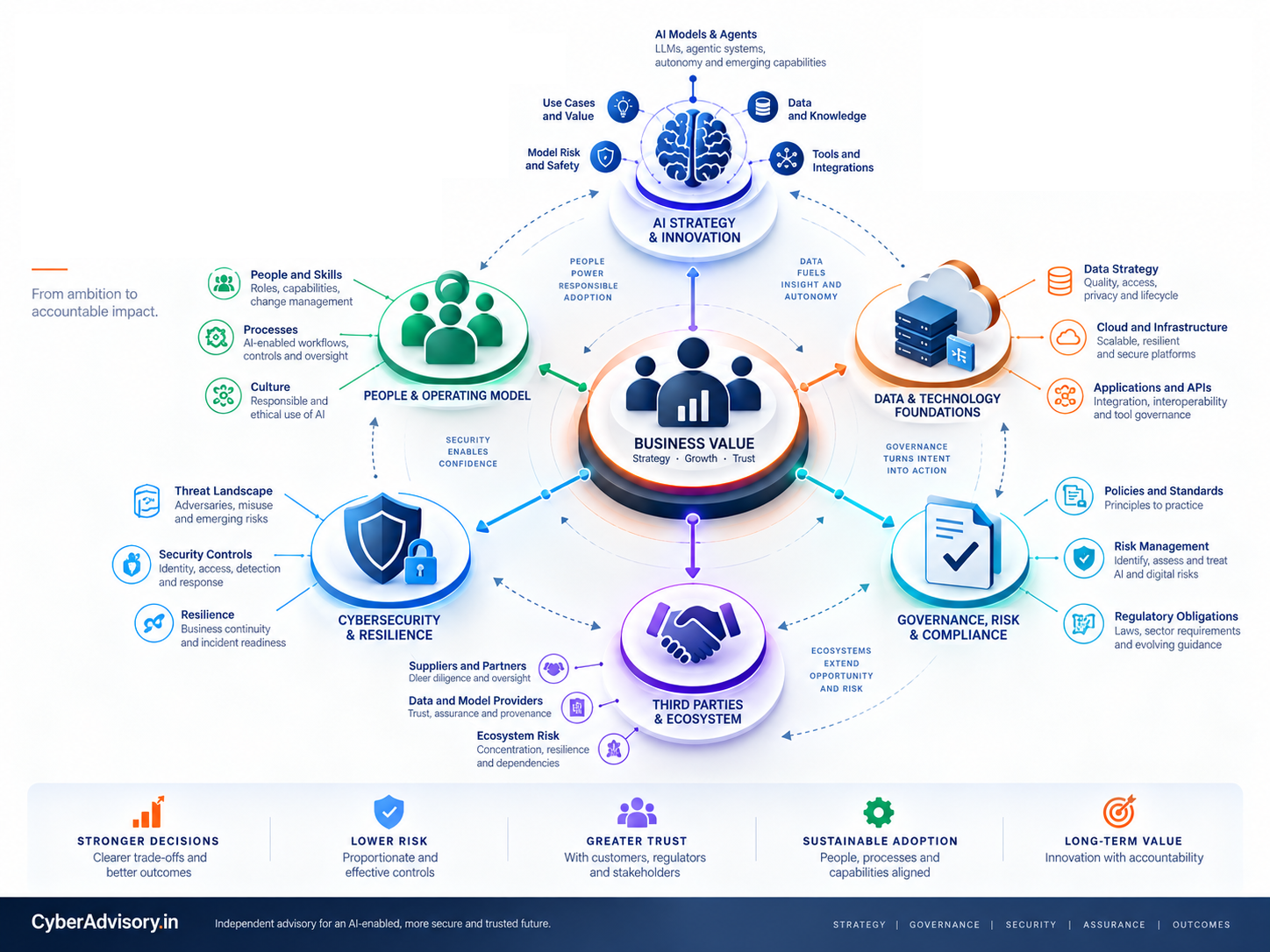
Enterprise AI decisions rarely exist in isolation. AI strategy affects data, identity, cloud architecture, third-party dependencies, cybersecurity, governance, regulatory obligations and operating models.

Agentic AI adds another dimension. AI systems can increasingly select tools, retrieve information, interact with enterprise applications and execute actions with varying levels of autonomy.

Effective advisory therefore goes beyond technology selection or policy creation. Leadership needs clarity about the business objective, material risks, decision rights, technical boundaries, control effectiveness and the evidence used to demonstrate responsible operation.

  • Connect AI investment with measurable business outcomes.
  • Establish governance before autonomy becomes difficult to control.
  • Align security controls with actual enterprise exposure.
  • Create evidence that supports management oversight and assurance.
Illustration connecting enterprise AI strategy, governance, cybersecurity, assurance and digital risk

CORE ADVISORY AREAS

Six connected advisory disciplines.

Each discipline can be engaged independently. The highest-value questions, however, frequently cross AI strategy, governance, autonomous systems, information security, cybersecurity and assurance boundaries.

01

AI Strategy & Transformation

Independent AI strategy advisory to determine where AI can create meaningful enterprise value and how investment should connect with business priorities, operating-model change, governance, security and measurable outcomes.

Scope can include opportunity portfolios, AI roadmaps, operating models, build-versus-buy decisions, capability requirements and executive decision frameworks.

Explore AI strategy advisory →
02

AI Governance & Responsible AI

Design practical AI governance around accountability, decision rights and risk rather than policy alone.

Scope can include AI inventories, risk classification, governance operating models, lifecycle controls, Responsible AI principles, human oversight, third-party AI governance and executive reporting.

Explore AI governance advisory →
03

Agentic AI Security & Responsible Autonomy

Security and governance for AI agents capable of accessing data, using tools, interacting with applications and taking actions with limited human intervention.

Scope can include agent identity, authorization, least privilege, tool controls, memory protection, delegation, human oversight, runtime monitoring and auditable actions.

Explore Agentic AI security →
04

AI Assurance & ISO/IEC 42001

Independent AI assurance focused on whether governance and controls operate effectively and whether management can demonstrate that effectiveness through credible evidence.

ISO/IEC 42001 advisory can support AI management-system design, governance, AI risk processes, control mapping, documentation, evidence development and readiness.

Explore AI assurance →
05

ISO/IEC 27001 & Information Security Management

Independent advisory for organisations establishing, reviewing or strengthening an Information Security Management System and the governance supporting information-security risk.

Scope can include ISMS boundaries, risk assessment, risk treatment, control ownership, Statement of Applicability considerations, policies, evidence, management review and continual improvement.

Explore ISO/IEC 27001 advisory →
06

Cybersecurity & Digital Risk

Independent cybersecurity advisory for architecture, transformation and enterprise-risk decisions across modern digital environments.

Scope can include identity, cloud security, Zero Trust, secure engineering, DevSecOps, resilience, third-party exposure, security operations and cyber-risk governance.

Explore cybersecurity advisory →

WHEN ADVISORY HELPS

Independent support for decisions where technology, governance and risk intersect.

Advisory is particularly valuable before an organisation commits to an architecture, AI programme, governance model, management system, security transformation or material technology investment.

Before major AI investment

Clarify the business problem, value hypothesis, operating-model implications, dependencies and risks before technology choices become expensive to reverse.

Moving AI into production

Establish accountability, governance, security boundaries, lifecycle controls and evidence as AI becomes embedded in operational business processes.

Introducing AI agents

Define acceptable autonomy, permissions, data boundaries, tool access, monitoring and human intervention before agents receive consequential capabilities.

Establishing an ISMS

Structure information-security governance, risk assessment, treatment, controls and evidence for an effective ISO/IEC 27001-aligned management system.

Establishing AI governance

Translate AI principles into ownership, decision rights, risk processes, lifecycle controls, oversight and measurable management practices.

Challenging a critical programme

Independently test assumptions, architecture, controls and programme priorities before consequential decisions reach approval or implementation.

INTEGRATED GOVERNANCE & ASSURANCE

Connect AI governance with information security without confusing their objectives.

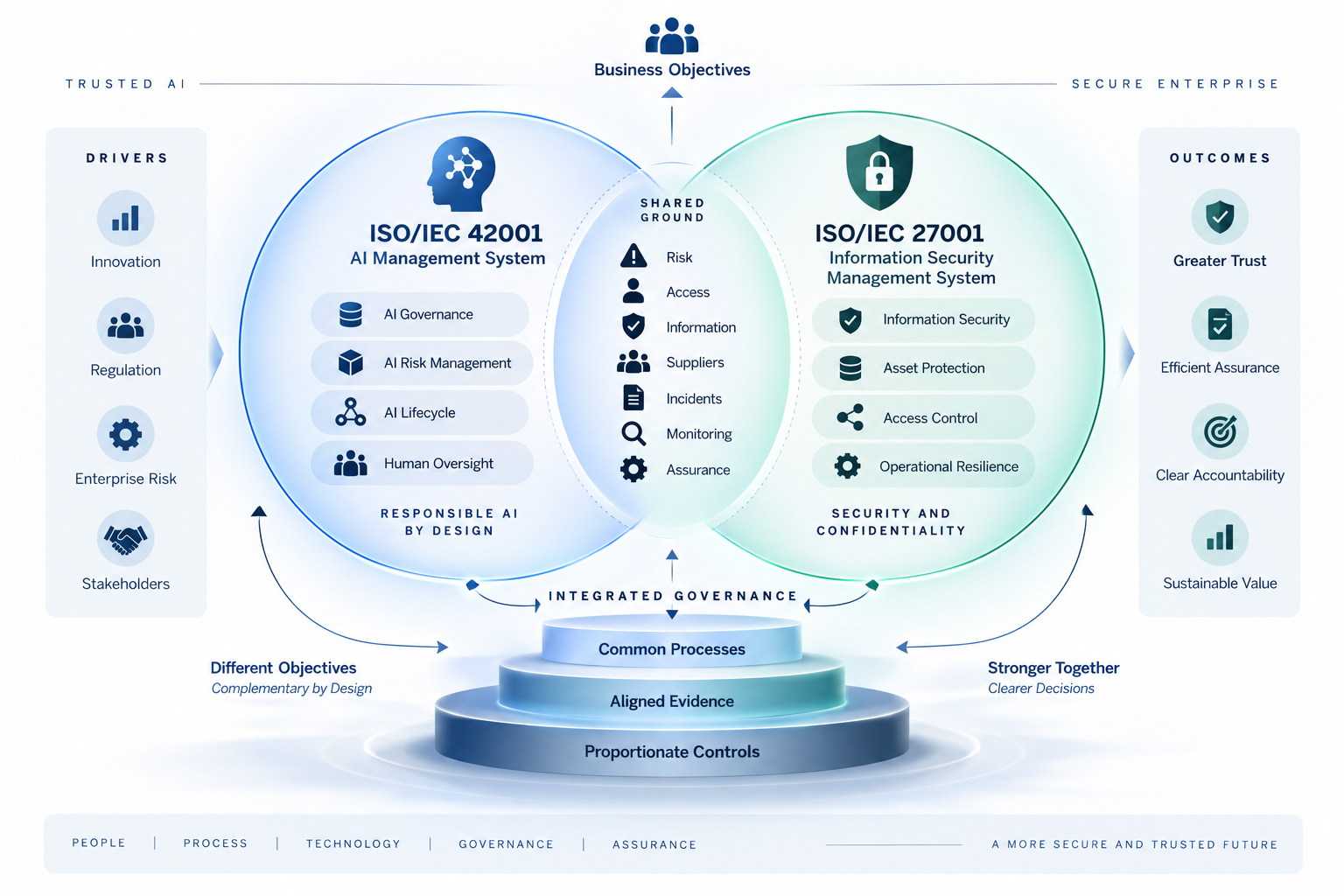
ISO/IEC 42001 and ISO/IEC 27001 address different management-system objectives. In enterprise environments, however, their implementation can touch common governance and assurance processes.

Relevant intersections can include risk ownership, access management, information protection, supplier relationships, incident management, monitoring, internal review and evidence management.

Advisory can help determine where processes should be coordinated, where evidence can be reused and where AI-specific risks require distinct governance and controls.

  • Preserve clear ownership between AI and information security governance.
  • Identify sensible management-system integration points.
  • Reduce unnecessary duplication of controls and evidence.
  • Maintain explicit treatment of AI-specific risks.
Illustration showing coordinated AI governance, ISO IEC 42001, ISO IEC 27001, cybersecurity and assurance

ADVISORY APPROACH

Start with the decision, not the framework.

Standards, frameworks and technology platforms are useful instruments. They are not substitutes for understanding the business decision, the material exposure and the outcome leadership needs to achieve.

01 · DECISION

Frame the decision

Define the business objective, stakeholders, assumptions, constraints and decisions leadership actually needs to make.

02 · EXPOSURE

Understand exposure

Examine architecture, data flows, dependencies, autonomy, threat exposure, governance obligations and credible failure scenarios.

03 · CONTROLS

Prioritise controls

Focus governance and technical controls on material risks rather than accumulating requirements without considering effectiveness.

04 · ACCOUNTABILITY

Define accountability

Establish decision rights, ownership, escalation routes and appropriate human oversight for technology and risk decisions.

05 · EVIDENCE

Build defensible evidence

Determine how management can demonstrate that critical controls exist, operate as intended and produce evidence suitable for review and assurance.

06 · IMPROVEMENT

Improve continuously

Use incidents, monitoring, assurance findings and changing technology exposure to refine governance and controls over time.

COMMON ADVISORY QUESTIONS

AI, cybersecurity and ISO advisory explained.

Direct answers to common questions about advisory scope, AI governance, information security and assurance.

What does AI and cybersecurity advisory cover?

AI and cybersecurity advisory helps leadership teams make informed decisions across AI strategy, governance, Agentic AI, AI security, assurance, information security, cybersecurity architecture and enterprise digital risk. The scope should be shaped by the decision or exposure requiring independent challenge.

What is ISO/IEC 42001 advisory?

ISO/IEC 42001 advisory supports organisations designing, reviewing or improving an AI management system. Work can include governance, accountability, AI risk management, operational processes, control mapping, documentation, evidence and management-system readiness.

What is ISO/IEC 27001 advisory?

ISO/IEC 27001 advisory supports organisations establishing, reviewing or improving an Information Security Management System. Areas can include ISMS scope, security-risk assessment, risk treatment, governance, control ownership, Statement of Applicability considerations, evidence, management review and continual improvement.

Can ISO/IEC 27001 and ISO/IEC 42001 be coordinated?

Yes. They have distinct objectives, but relevant governance, risk, monitoring, audit and evidence processes can be coordinated. The aim should be practical integration where appropriate without obscuring AI-specific or information-security-specific responsibilities.

What does Agentic AI security advisory address?

Agentic AI security addresses the risks created when AI systems can use tools, retrieve information, access applications, retain context or take actions. Important areas include agent identity, authorization, least privilege, memory protection, delegation, runtime monitoring, human oversight and auditable actions.

Is advisory the same as ISO certification?

No. Advisory can help an organisation design, evaluate and improve its management system and prepare for independent assessment. Formal certification is a separate activity performed by the relevant independent certification body.

RESEARCH

Independent analysis on enterprise AI, cybersecurity and assurance.

Explore analysis on emerging AI architectures, Agentic AI, governance, security, assurance and the changing relationship between enterprise technology and digital risk.

Explore research →

INDEPENDENT ADVISORY

Complex technology. Clearer risk decisions.

For AI strategy, AI governance, Agentic AI security, AI assurance, ISO/IEC 42001, ISO/IEC 27001, cybersecurity or digital-risk requirements, start with the decision you are facing and the context surrounding it.

Discuss an Advisory Requirement ↗