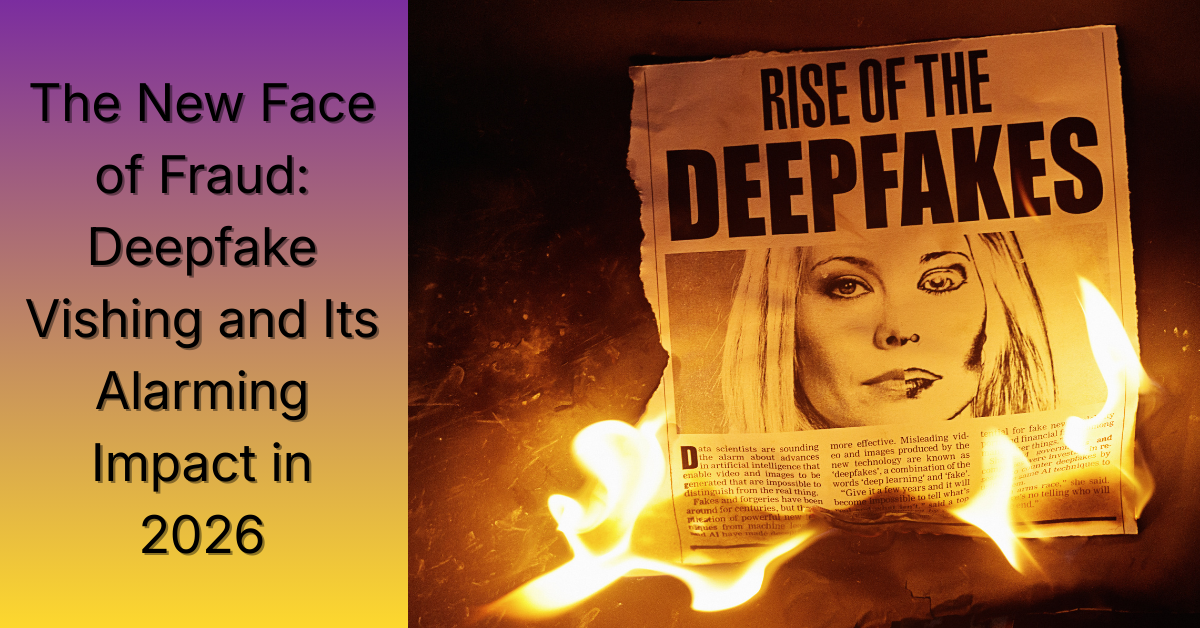
The New Face of Fraud: Deepfake Vishing and Its Alarming Impact in 2026
When the Voice on the Phone Is No Longer Human
Imagine receiving a call from your CEO, their familiar tone laced with urgency, instructing you to immediately wire funds to a new vendor. Or a call from a loved one, their voice strained, claiming they’re in trouble and need money sent right away. Your brain, trained to trust these vocal cues, springs into action. But in 2026, that voice may have never belonged to a human at all. Welcome to the era of Deepfake Vishing—a sinister fusion of AI-generated audio and social engineering that is redefining cybercrime, shattering trust, and presenting unprecedented technical and psychological challenges.
Vishing, or voice phishing, is not new. But the integration of deepfake audio technology has transformed it from a crude scam into a highly personalized, scalable, and devastatingly effective weapon. As we stand in 2026, the technology has moved from proof-of-concept nightmares in cybersecurity labs to widespread, commodity-level attacks affecting individuals, corporations, and political systems globally.
Technical Deep Dive: The Engine Behind the Illusion
To understand the threat, we must dissect the technology powering it. Deepfake vishing in 2026 relies on a sophisticated stack of AI models, data harvesting, and real-time processing.
1. The Core Architecture: Advanced Audio Models
Gone are the days of requiring hours of a target’s voice data. The state of the art in 2026 is built on a new generation of few-shot and zero-shot voice cloning models. These systems, often based on architectures like VALL-E 3 or custom Diffusion-based Vocoders, can synthesize a convincing vocal clone from as little as a 3-5 second audio clip—a snippet easily scraped from a social media video, public webinar, or even a voicemail greeting.
The real breakthrough has been in emotional latency and prosody control. Early deepfake voices sounded flat or robotic. Today’s models use contextual emotion embeddings, allowing the attacker to dial in specific emotional states—urgency, fear, authority, warmth—with slider-like precision, making the social engineering hook infinitely more persuasive.
2. The Data Pipeline: The Silent Harvest
The attack begins long before the call is placed. Automated bots scour the internet for voiceprint sources: YouTube channels, TikTok clips, corporate podcasts, Instagram Stories, and video conferencing archives (often leaked or publicly posted). This data is indexed and cataloged in dark web marketplaces, where voice profiles of executives, public figures, and even mid-level finance managers are sold as digital commodities.
In a more targeted attack, attackers may use spear-phishing to elicit a voice sample. A simple “Can you reply to this with a voice note?” or a fake survey call can provide the raw material.
3. Real-Time Synthesis & The End of the “Lag” Giveaway
A critical technical hurdle overcome by 2026 is real-time interactive deepfake vishing. Previously, deepfake calls were largely pre-recorded messages. Now, with edge-optimized AI models and low-latency cloud APIs, attackers can generate synthetic speech live, during a two-way conversation.
The system works in a loop:
- The attacker types (or uses a pre-written script) what they want the cloned voice to say.
- The model generates the audio in under 300 milliseconds, injecting appropriate breaths, pauses, and filler words (“um,” “ah”).
- The synthetic audio is played to the victim over a VoIP line.
- The victim responds.
- A separate AI (a Large Language Model) analyzes the victim’s response and suggests or auto-generates the next line of dialogue for the attacker.
This creates a terrifyingly fluid and adaptive fraudulent conversation.
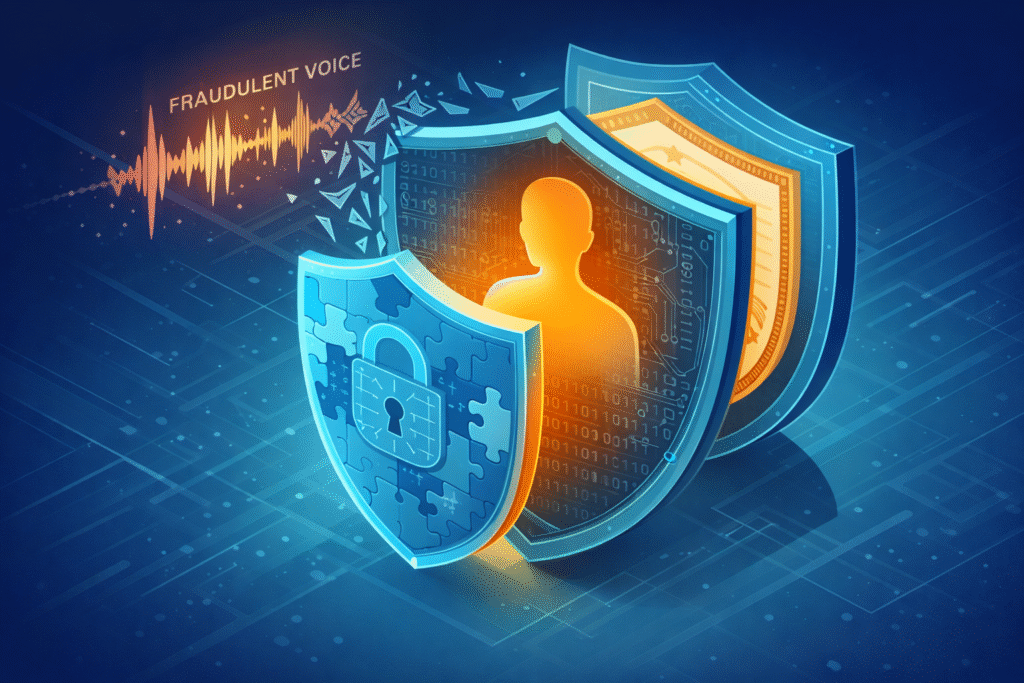
Defenses combine AI detection, strict human processes like multi-factor verification, and new laws to counter deepfake voice fraud. Trust must be verified, not assumed.
The Threat Landscape in 2026: Use Cases & Impacts
The applications of this technology are as diverse as they are damaging.
1. Corporate Fraud & The CFO Impersonation Crisis
This is the most costly category. Attackers clone the voice of a CEO, CFO, or a trusted vendor. In a typical Business Email Compromise (BEC)-style attack, now executed via voice, the “CFO” calls an accounts payable employee, confirms a recent (fake) invoice, and demands an immediate change in wiring instructions. The human voice commands more authority than an email. The FBI and global financial regulators reported a tripling of successful vishing-based wire fraud in 2025, with losses now routinely in the tens of millions per incident.
2. Personal & Familial Fraud: The “Grandchild in Trouble” Scam 2.0
This classic scam has been supercharged. Instead of a stranger claiming your grandson is in jail, it’s your grandson’s voice, crying and begging for bail money. The emotional hijacking is instantaneous and overwhelming. Senior citizens are particularly vulnerable, but these attacks are increasingly tailored against parents using clips of their children mined from family social media accounts.
3. Political Chaos & Disinformation
Deepfake vishing isn’t just for theft. In 2026, we’ve seen its weaponization in politics. A fabricated audio clip of a candidate making a racist remark or confessing to a crime can be generated and disseminated in minutes. More insidiously, real-time vishing can be used to manipulate events: a fake call from a military commander to a border post, or from a news editor to a reporter, could trigger real-world consequences before the fraud is detected.
4. Identity Theft & Security System Breach
Voice-based authentication, once touted as a secure biometric, is now fundamentally broken. Attackers can bypass bank phone lines, secure facility access systems, and even certain government service portals that still rely on “voice print” verification.
The Defense Arsenal: Fighting Fire with AI
The cybersecurity industry is in an arms race. Defensive strategies in 2026 operate on multiple layers.
1. Detection Technology: The AI Watchdog
- Liveness Detection: Systems now analyze audio for signs of synthesis, looking for artifacts imperceptible to the human ear. This includes analyzing the spectral phase coherence and micro-tremors present in human vocal cords but missing or distorted in AI-generated audio.
- Contextual & Behavioral AI: Defense systems don’t just listen to how something is said, but what is said and the context. An AI monitor on a corporate line might flag a call as high-risk if a “CEO” suddenly requests an urgent wire transfer—a significant deviation from their normal communication patterns and company policy.
- Blockchain-Verified Voiceprints: Some organizations are implementing systems where official executives register a cryptographically signed voiceprint on a secure ledger. Any call not matching this verified hash is automatically flagged.
2. The Human Firewall: Process Over Trust
The most critical defense is procedural. In 2026, best practice mandates:
- Multi-Factor Verification (MFV): Any financial or sensitive instruction received via voice must be verified through a separate, pre-established communication channel—a physical token, a secure messaging app with prior contact, or an in-person conversation.
- Code Words & Duress Phrases: Organizations are adopting dynamic duress phrases for high-stakes verbal instructions.
- Awareness Training: Training now includes listening to examples of deepfake vishing to educate employees on the uncanny valley of voice—sometimes there’s a subtle “digital whisper” or unnatural cadence that can raise suspicion.
3. Regulatory & Legal Framework
Governments are scrambling. By 2026, several jurisdictions have passed “Digital Impersonation” laws with severe penalties. There is also a push for watermarking standards for AI-generated audio, though enforcement against bad actors remains challenging.
Deepfake Vishing Defense Matrix 2026
Multi-layered protection strategies against AI-powered voice fraud
| Defense Layer | Key Strategies | Technical Implementation |
|---|---|---|
AI Detection TechnologyReal-time Analysis
|
● Liveness Detection
● Contextual & Behavioral AI
● Blockchain-Verified Voiceprints
|
|
Human FirewallProcedural Defense
|
● Multi-Factor Verification (MFV)
● Code Words & Duress Phrases
● Awareness Training
|
|
Regulatory FrameworkLegal Protection
|
● Digital Impersonation Laws
● Watermarking Standards
|
|
The Ethical Abyss and Future Trajectory
The technology raises profound questions. As synthetic media becomes indistinguishable from reality, the very concept of “hearing is believing” evaporates. This leads to a “liar’s dividend,” where genuine audio can be dismissed as a deepfake, allowing malicious actors to evade accountability.
Looking ahead, the convergence of deepfake audio with real-time video deepfakes for video calls is the next frontier. Defending against a fraudulent video conference where every participant is a convincing deepfake will be the cybersecurity challenge of the late 2020s.
Conclusion: A Call for Vigilance in the Post-Truth Audio Age
Deepfake vishing in 2026 is not a speculative threat; it is a present and evolving reality. It exploits our most fundamental instinct: to trust the human voice. The technical genie is out of the bottle, and it speaks with perfect mimicry.
The solution lies in a triad of advanced technology, iron-clad human processes, and continuous education. As individuals and organizations, we must adopt a new principle: “Trust, but cryptographically verify.” Verify through independent channels, verify through process, and verify through a healthy, informed skepticism.
In this new age, the most important security upgrade may not be a new software, but a cultural shift—from inherent trust in our senses to verified trust in systems and relationships. The voice on the phone may lie, but our protocols and preparedness do not have to.